
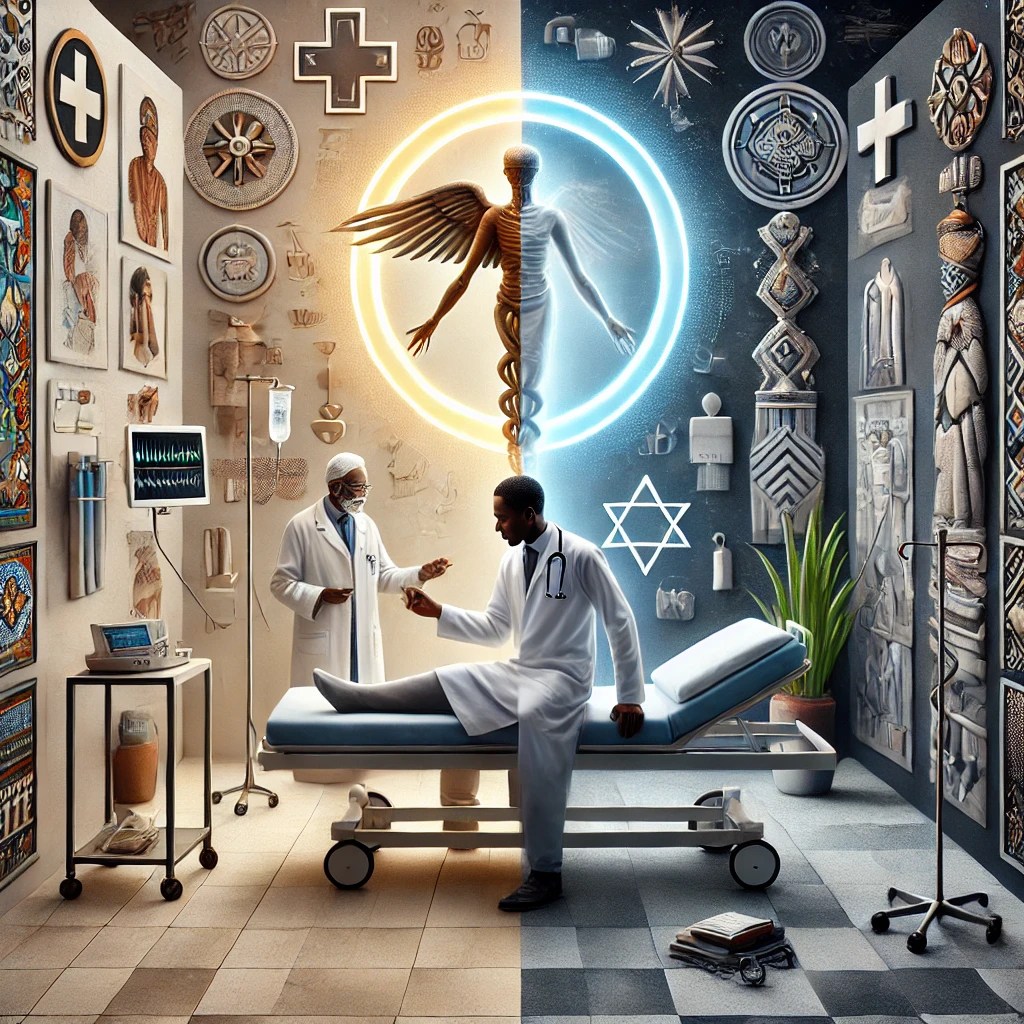
In writing about the relationship between religion and medicine, I have often struggled with the balance between saying too much or too little. Religion as practiced in Nigeria is heavily influenced by our culture—a culture rooted in the belief in supernatural beings capable of causing harm that cannot be remedied physically. It is akin to a Marvel story, where an unseen force causes illness, and only another force—a “hero”—can save the afflicted. Continuing with the analogy of heroes, it is important to note that heroes often leave some destruction in their wake while saving lives.
In moments when the unexplainable occurs, it is understandable that people turn to this great hero, who cannot be fully understood but is believed to wield immense power. In truth, most unexplainable phenomena can be understood through proper research. However, Nigerians are not known for doing things halfway; they always add a little extra spicing. They transitioned from trusting their old Gods—capable of everything—to trusting another’s God(s). Yes, I will write “Gods” with a capital G because, in equality of speech, no being or follower should claim superiority over another.
Religion has come to rely heavily on faith—believing in things without proof of their existence or effectiveness. Nigerians’ unwavering faith in everything except themselves might just be the first step toward the destruction of their own health. While we often discuss the need for a better healthcare system (and I do, too), I wonder if the deaths related to religious fanaticism will ever cease.
We’ve all heard stories of deaths occurring in churches—pregnant women who went to deliver in a church and died, or those who arrived at hospitals too late to save their babies. As intriguing as it might be to write or read about such cases, this is not the focus of this piece.
This write-up focuses on the dangers posed by religious fanatics within healthcare. A healthcare provider administering care with a touch of religion poses a significant risk. While one should be free to hold personal religious beliefs, those beliefs must be walled off while in the hospital environment. How many times have you shared your religion with your patients? Why is that even allowed? You cannot tell a diabetic patient to trust their medication and then undermine that trust by implying that only your God has real power.
The hospital is no place for the universality of a God. Every time a doctor walks into the hospital hoping to treat a patient with more than their medically trained knowledge, they risk becoming a danger to both medicine and society. Their religious beliefs seep through, soaks the air, and ultimately influencing their practice.
In the course of this writing, A healthcare provider argued that kindness is part of their religion, and walling off their faith would mean walling off kindness. However, kindness, an expression of empathy, has no inherent basis in religion. It concerns me even more when someone claims their kindness stems solely from religious faith—it suggests that kindness may be absent without it, rendering the action potentially insincere. This mindset requires evaluation by a trauma-focused psychiatrist.
The effects of such religious bias are most pronounced in counseling, where healthcare staff might begin and end sessions by invoking a God. Reflect on the strongest misconceptions you’ve encountered—they likely began during a visit to a doctor or nurse.
Healthcare practitioners should keep their faith private. The hospital is not a place to recruit new religious followers; it is where science heals and works. It is deeply unethical to attempt to convert patients at their most vulnerable, especially when your role is to provide clinical care and assessment.
In the end, this article may not solely be about medicine and religion but rather about the complex relationship between healthcare workers and their patients. If certain beings are believed to exist to address the unexplainable, perhaps the answer lies in patience—waiting for what seems unattainable to unfold in its own time.
Please share your thoughts on this. Lets discuss.

 Kandiee Scribbles
Leave a comment